
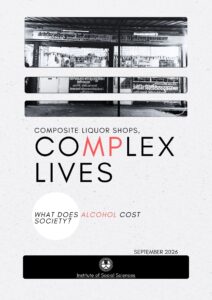
 During several recent visits to Madhya Pradesh for project work, I repeatedly came across prominently displayed “Composite Liquor Shops” along highways and in small towns.
As a student of mathematics, the word composite immediately caught my attention. I soon discovered that in Madhya Pradesh, a composite liquor shop is a licensed outlet where country liquor and foreign liquor are sold from the same place. A kind of “single-window system” for alcohol.
But my conversations in Gram Panchayats revealed a much more disturbing meaning of the word composite.
I saw desperation on the faces of young women whose husbands, they said, had stopped working because of alcohol. Some told us that even the benefit of free ration becomes meaningless when husbands take the family’s ration and sell it for cash to buy liquor. Young mothers with small children are then left to manage the household on their own.
Several women told us that they go out at night to irrigate fields, sometimes risking their safety and dignity, because their husbands are too intoxicated to work. Others described husbands who have become so physically weak that they cannot lift a bucket of water, yet remain capable of raising a stick against their wives.
In some communities, people claimed that 60–70% of young men in their twenties and thirties were seriously dependent on alcohol. I have not independently verified these local estimates, and therefore do not present them as statistics. But the consistency and emotion with which these stories were narrated cannot easily be ignored.
Madhya Pradesh earned around ₹17,700 crore in State Excise revenue in 2025–26, with the 2026–27 budget targeting about ₹20,280 crore.
The question is not simply how much revenue alcohol generates.
The real question is: what does alcohol cost society?
Lost working days. Lost household income. Domestic violence. Health expenditure. Accidents. Law-and-order costs. Children growing up in insecure homes. And perhaps most importantly, the loss of human productivity and dignity.
We routinely calculate the revenue generated by alcohol.
Perhaps it is time to calculate the social cost of generating that revenue.
This deserves serious, evidence-based public-policy research.